

Pre-alignment inspection
We check tire pressures, wear patterns, ball joints, tie rods, and bushings first. There's no sense aligning a vehicle with a worn suspension part — it'll just go right back out.
A computerized 4-wheel alignment dials in three suspension angles — camber, caster, and toe — to your vehicle's factory specification. The result: even tire wear, straight-tracking steering, and a vehicle that drives the way the engineers intended.
Hit a pothole, scrape a curb, or just rack up enough miles and your suspension geometry drifts away from factory spec. The angles are tiny — a fraction of a degree — but the consequences add up fast.
A quarter-degree of "toe" misalignment can scrub a tire's tread off in 10,000 miles instead of 50,000. A misaligned vehicle also wastes fuel because tires are fighting each other instead of rolling freely. And a vehicle that pulls or wanders is harder to control in an emergency maneuver — the steering input you make has to overcome the alignment problem before it can move the car.
An alignment is the single cheapest way to extend the life of a brand-new set of tires and get the handling back to what the manufacturer designed.
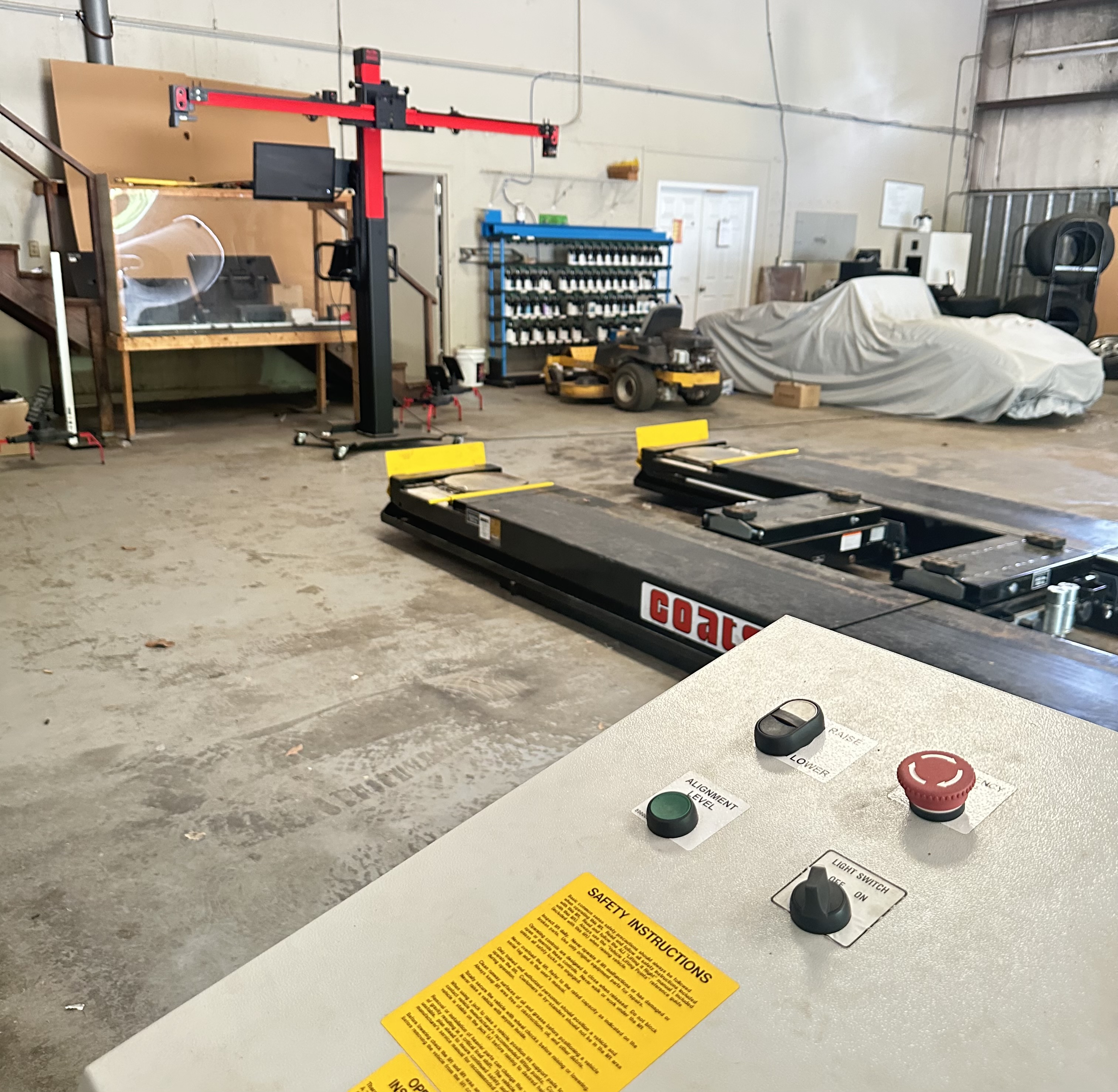
We use a computerized 4-wheel alignment rack that measures every angle to within hundredths of a degree.
We check tire pressures, wear patterns, ball joints, tie rods, and bushings first. There's no sense aligning a vehicle with a worn suspension part — it'll just go right back out.
Camber is the inward/outward tilt of the wheel. Caster is the forward/back tilt of the steering axis. Toe is whether the wheels point inward or outward. We adjust each one to your vehicle's spec.
Front and rear alignment are linked — a misaligned rear axle makes the front fight to compensate. We measure all four wheels and align them to each other and to the vehicle's centerline.
You leave with a printed report showing where each angle started, where the spec is, and where we set it. No guesswork, no "trust us" — measured numbers.
Most alignment problems are subtle until you know what to look for.
Hands off the wheel for a moment on a straight, level stretch — if the car drifts to one side, alignment (or a tire) is the most common culprit.
If your logo or steering spokes sit crooked while you're tracking straight ahead, the toe is out of spec.
Run your hand across the tread (carefully). If one edge is worn smooth and the other still has tread, or you feel sharp "feathers" — that's a misalignment fingerprint.
An impact strong enough to bend a wheel or shift a control arm will throw the alignment off. Get it checked even if the vehicle still drives "okay."
This is the highest-value moment for an alignment. Putting fresh rubber on a misaligned vehicle wastes tread on day one.
Most alignments take about an hour. We'll diagnose, adjust, and hand you the printout before you leave.
An alignment with new tires is one of the highest-value combos in auto care. We'll get the most life out of your set.
Worn struts, ball joints, or tie rods make alignments impossible to hold. We'll diagnose and fix what's needed.
If your vehicle pulls under braking, the cause may be in the brake system — not the alignment. We'll check both.