

Free load test
We hook up a digital tester that simulates a starter draw and reports cold-cranking amps, internal resistance, and state of charge. You see whether the battery is healthy, weak, or failed.
Free battery testing, professional installation, and a full charging-system check before you drive away. The Georgia heat is brutal on batteries — knowing where yours stands beats getting stranded.
The 12-volt battery delivers the massive burst of current that spins the starter and fires the engine. But once the engine is running, the alternator takes over and the battery becomes a giant electrical buffer — smoothing voltage spikes and keeping the dozens of computers in a modern vehicle happy.
Modern vehicles are harder on batteries than ever. Start-stop systems cycle the battery dozens of times per drive. Heated seats, infotainment screens, and a constant trickle of "key-off" power for keyless entry and security all pull from the battery even when parked.
And then there's the heat. Here in south Georgia, batteries usually fail not in the dead of winter but at the end of a brutal summer — heat dries out the electrolyte and corrodes the internal plates. Most batteries in our climate last 3 to 5 years. Knowing where yours stands is the difference between a planned $200 replacement and a tow on a Sunday morning.
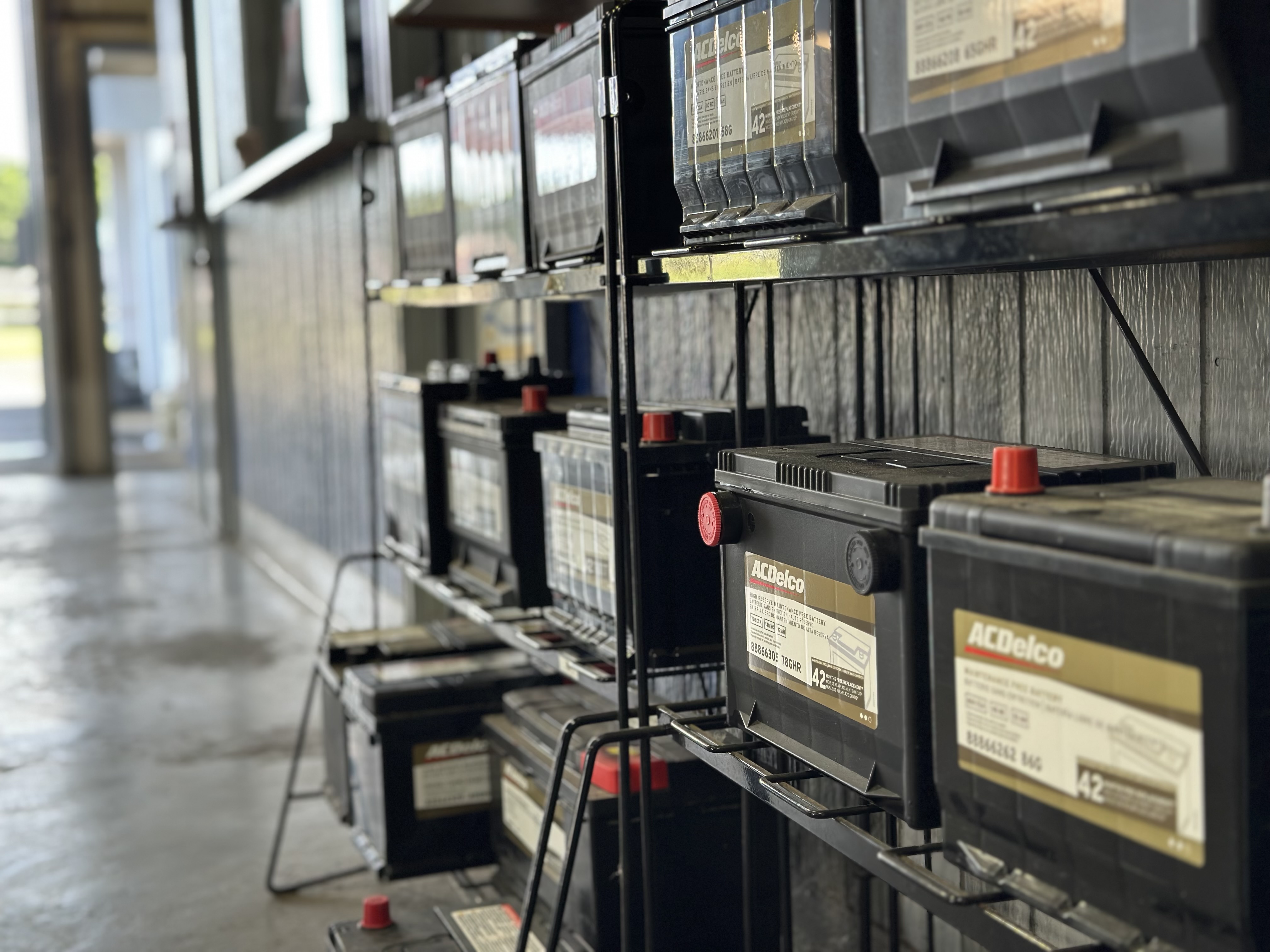
A battery is the easy part. Doing the rest of it right is what keeps you from being back in two weeks.
We hook up a digital tester that simulates a starter draw and reports cold-cranking amps, internal resistance, and state of charge. You see whether the battery is healthy, weak, or failed.
Modern vehicles lose radio presets, climate settings, even transmission learning when the battery disconnects. We use a memory-saver to keep power to the computer during the swap.
Group size, cold-cranking amps, AGM vs flooded — we match the OEM spec exactly. Quality NAPA batteries with a full warranty included.
Corroded terminals make new batteries look bad. We clean both posts and clamps, apply anti-corrosion treatment, and torque the connections to spec.
A bad alternator will kill a brand-new battery in days. Before you leave, we verify the alternator is delivering 13.8–14.7 volts and the system has no parasitic drains.
Many newer vehicles need the new battery "registered" with the body control module so the charging system treats it correctly. We have the scan tools to do it.
A failing battery usually gives you days of warning. A failed battery doesn't.
The starter sounds labored or "lazy." On modern engines this is the clearest early warning. Bring it in before the next start fails completely.
The battery is no longer holding voltage on its own — the alternator is having to do the work. A classic late-stage battery symptom.
The battery icon usually means a charging-system fault. Could be the battery, the alternator, or wiring — we'll diagnose which.
White or blue powder around the battery posts is a sign the battery is venting acid — usually from heat damage or overcharging. Have it tested.
Most batteries in Georgia heat last 3–5 years. After year three, get it load-tested every visit so you can plan a replacement on your schedule, not the battery's.
One jump can be a fluke (lights left on, etc). Two jumps in a few months means the battery isn't holding charge anymore — replace it before you're stranded somewhere worse.
Drop in or book online. The test takes a couple of minutes and tells you exactly what your battery has left.
If the alternator isn't charging properly, no battery will last. We test the whole system together.
Mysterious dead batteries often trace to a "parasitic drain" — something pulling power when it shouldn't. We track them down.
Pair a battery test with your next oil change — both are quick, free to test, and easy to do in one visit.